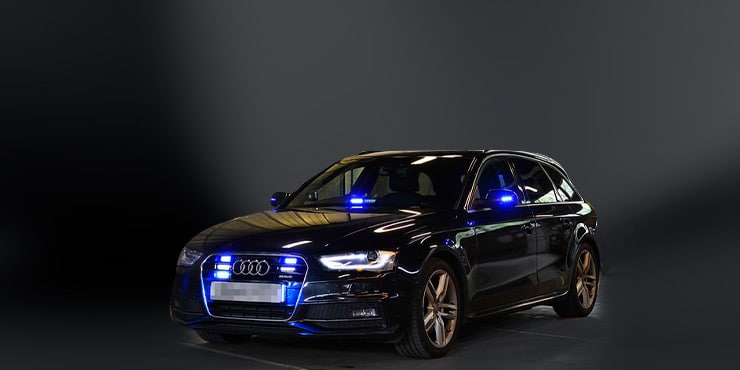
Best Way to Spot Unmarked Police Cars
Imagine driving down the highway at night after a long day at work, listening to your favorite song or radio station, and cruising beyond the speed limit—only to find out a police or traffic enforcer is flashing lights in your vehicle. You may not have noticed them because that police or traffic enforcer was sitting near their unmarked vehicle, parked somewhere hidden. It will be tricky for an ordinary person to differentiate an unmarked police car from a normal civilian’s vehicle because both have similar features. In today’s article, we will discuss what an unmarked police car is and the best ways to identify such vehicles.
Purpose of Unmarked Police Cars
Lifehacker said an unmarked police vehicle is different from an undercover cop’s car because a police that undergoes an undercover operation won’t be using a police car, of course, and is posing as someone else. An undercover police uses an unmarked car or a vehicle without any visible markings or stickers outside that indicate it is used for police operations. Usually, the police opt for white, black, or silver cars and the color will be the same as the standard police car sans the badges.
The police, in particular, use unmarked police cars instead of the usual patrol car to monitor motorists plying the road and, at the same time, avoid intimidating the public. That way, it will be easier to observe if professional and non-professional drivers are following traffic rules without giving away they are police. When they spot a vehicle driving recklessly, they will be able to avert any potential accidents.
Traffic enforcement is the primary reason of police or traffic enforcers for using such cars. All told, any police officer, whether using a marked or unmarked vehicle, may pull you over if they found out you violated traffic rules. Some of the offenses include failure to yield; overspeeding; driving with insufficient documents, registration stickers or expired driver’s license; parking in a fire lane; turning into the wrong lane; and vehicle faults (cracked or malfunctioning lights).
Guidelines on Unmarked Police Cars
Since unmarked police vehicles do not have any marks or specific features, it is difficult for anyone to spot an unmarked police car. As a rule of thumb, all unmarked vehicles should be less than three years old and in good working condition. Moreover, police’s unmarked fleet vehicles do not have any decoration such as fancy rims. Unmarked police vehicles, which only use simple steel reems, usually with a small chrome center cap, should drive at a constant speed and won’t attempt to overtake a civilian’s car. The police make it a point to keep these vehicles clean yet they carry special and state-issued police license plates whose color is different than the regular license plate.
Unmarked police cars, often identified as a generic police car, are meant to fulfill their job—mainly to ensure smooth traffic. They are allowed to ask a motorist to pull over yet, in compliance with the existing law, the officer driving and/or riding inside the car must wear their uniform. Police are able to stop cars that violated traffic rules if they are in uniform. Under Section 163 of the Road Traffic Act 1988, a constable in uniform is given the authority to stop a possible erring vehicle that is being driven on the road. The driver in question must stop the vehicle if asked by those police.
If ever an unmarked police car signals you to pull over, authorities have some advice for motorists. First is to trust your instinct. This old adage applies even until now as it teaches us to trust our feelings or intuition, especially if we feel something is wrong. If there are enough reasons to believe that the unmarked vehicle is not a police-issued vehicle, do not stop. When in doubt, call the police hotline and the police can validate from their end if the unmarked police vehicle that asked you to stop is indeed one of their cars.
Another is to keep the doors locked until it’s been confirmed that indeed it is a legitimate unmarked police car. If a police sends a signal to pull over, flash a light or signal to inform them that you have recognized their request to stop the vehicle and drive slowly as speeding up implies you want to run away from them. At this point, the person is allowed to check an officer’s warrant card indicating their name and other relevant information. In turn, the police officer will ask for personal details including full name and date of birth. When your vehicle is signaled to stop, it is advised to go to the nearest police station or public place and never stop in a secluded place.
Be on the Lookout for Fake Unmarked Police Cars
What the article wishes to impart to the public is that by knowing these guidelines on unmarked police cars, hopefully one can gauge if a police officer is overstepping his authority. For one, the police officer/constable must always be in uniform before they can have the authority to ask motorists to pull over.
Not all unmarked vehicles hiding somewhere are from the police. Various articles on the internet have warned the general public to be on the lookout for fake unmarked police vehicles that only seek to extort money from motorists. Ebby Tremain, in an interview, recalled how a bogus undercover policeman flashed blue lights on them and signaled to pull over. The person was traversing between Reduth and Helston when she saw a blue or silver Vauxhall in the rear-view mirror. At first, Tremain believed it was an unmarked police car. However, after pulling over and getting out of the car, a man got out of the supposed unmarked vehicle and decided to drive away. Tremain said the same man pursued her but afterward, turned off on an unclassified road leading to a school, fueling her doubts if the person is part of the police force. Devon and Cornwall Police advised motorists to never stop the car and keep driving when in doubt.
Another young woman in Queensland, Australia posted on social media about a similar incident. A certain Chloe narrated she felt unsafe after an unmarked police vehicle signaled her to stop the car while driving between Southport and Toombul, both suburban towns in Brisbaine. Listening to her gut, Chloe remembered her parents’ advice and called 112 from her smartphone. The police then informed her that the unmarked car behind her was not a police car. Turns out, Chloe’s social media post was a hoax, as confirmed by local authorities in Queensland.
This article was prepared by the Association Against Abuse of Police Powers and Privileges (AAAPPP), a UK not-for-profit organisation specializing in assisting victims of abuse of power and corruption in the UK Police.
Leave a Reply